
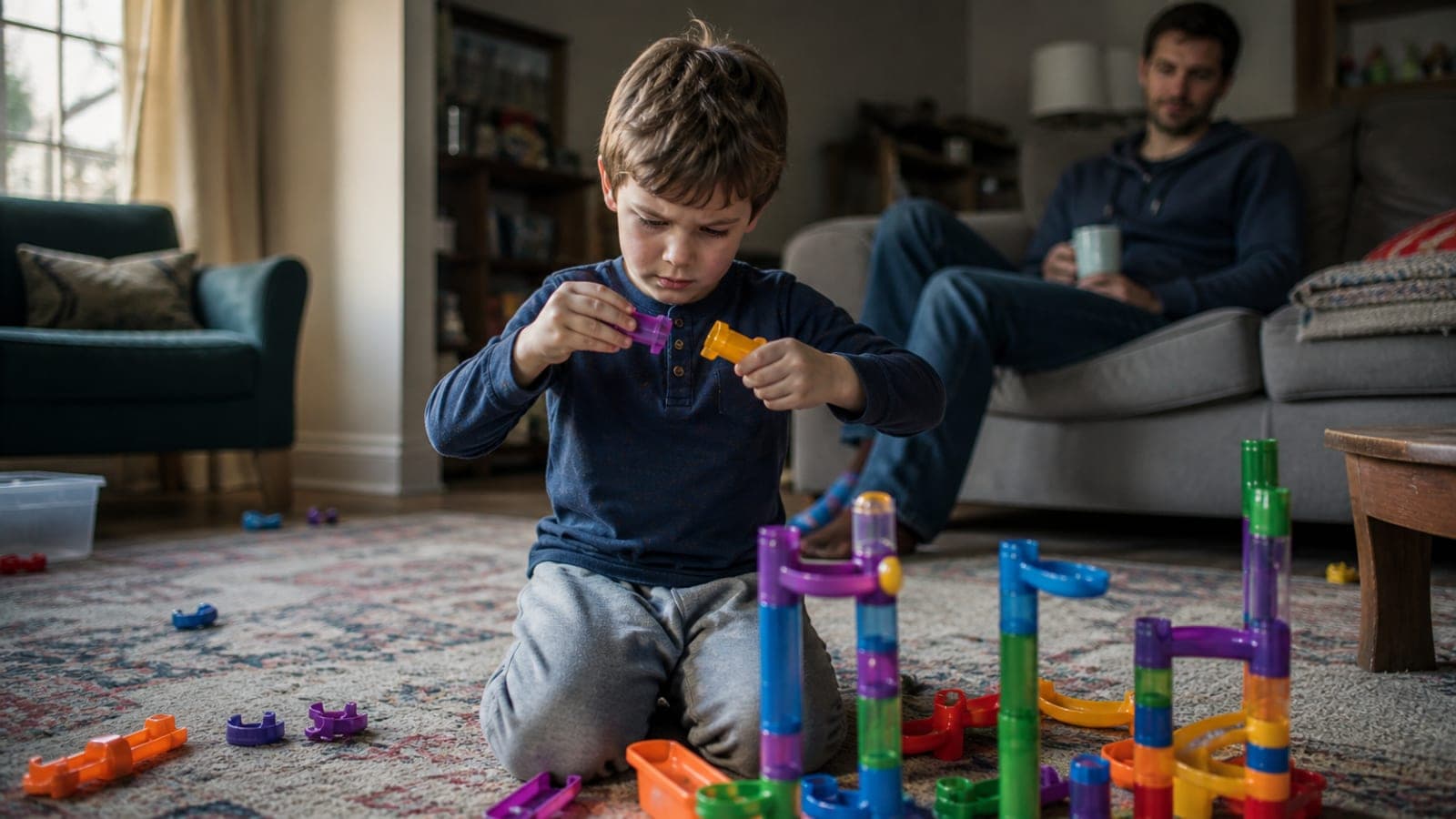
Key takeaways
- Give the least help that keeps your child moving, then withdraw it as soon as they are moving again.
- In a filmed study of parents and preschoolers solving a puzzle, good helping followed one rule: ease off after a success, get more concrete after a failure.
- Preschoolers shown how a toy worked by a teacher-like adult played with it for less time and tried fewer things with it than children left to find out for themselves.
- A review pooling 17 studies and 3,893 children found guided play ahead of direct instruction on early math, shape knowledge and task switching.
- Ask before you tell. A question leaves the problem with your child; an answer moves it to you.
A child who asks for help with every stuck zipper is not lazy, and a child who abandons the marble run the moment it comes apart is not giving you a character flaw to fix. Both have hit a gap between what the problem needs and what they can currently do, and both are looking to you to close it.
The useful move is smaller than most advice suggests. Give the least help that keeps them moving, then take it back as soon as they are moving. Not a lesson, not a five step framework, and not walking away. One notch of help, offered late and withdrawn early, repeated for about a decade.
Why the answer is the expensive kind of help
Researchers gave preschoolers a toy with four non-obvious things it could do, one of them a squeaker hidden inside a tube. Some of the children watched an adult demonstrate one of those functions in an unmistakably teacherly way. Others saw the same function revealed by accident, or by an adult who appeared not to know what the toy was.
Then every child was left to play. The ones who had been taught played for less time and tried fewer different things with the toy. The ones who had not been taught kept poking at it, and found more of what it could do.
The authors' own summary is the part worth carrying around: instruction limits spontaneous exploration and discovery. Teaching works, and it is efficient. It also quietly tells a child that the demonstrated thing is the thing, and that there is no particular reason to look for anything else.
That trade is fine when you want a specific fact learned quickly. It is a bad trade when what you wanted was a child who keeps looking.
The help ladder
The clearest picture of what good helping looks like comes from a study that filmed 117 parents and their children, average age just under four, working through a five minute puzzle together, and then tested the children again a year later.
Every single thing a parent did was sorted into one of five kinds, running from the vaguest to the most concrete:
- A nudge about where to start. "Let's start with the corners."
- A pointer at one piece or one place. "Try turning that one around."
- The answer, spoken. "This piece goes here."
- The answer, handed over. Passing the child the right piece for the gap they are staring at.
- The answer, done. Putting that section of the puzzle together yourself.
None of those five is wrong. Level five is exactly right for a two year old at the end of a long day. What separated the parents whose children did best was not which rung they used, it was how they moved between them: a child's success was followed by help at the same level or a vaguer one, and a failure by help one or two steps more concrete. Ease off when it is working. Get specific when it is not. Then ease off again.
A year on, the children whose parents had done more of that had stronger executive function, which is the bundle of skills covering holding a goal in mind, resisting the first impulse, and switching approach when the first one fails. In that study, executive function turned out to be what carried the effect through to the children's early literacy and numeracy.
Open vaguer than feels natural
Most of us open at level three. The child is stuck, the answer is sitting right there, and saying it costs two seconds.
Open at level one instead and you will be surprised how often it is enough, because a child who is stuck is usually not missing the solution. They are missing a place to put their attention. "What have you tried?" is doing real work: it makes them look back at their own attempts, which is the part they skipped.
Wait longer than is comfortable
The few seconds after a child stalls are the whole thing. It is where the second idea comes from, and it is also the most uncomfortable stretch of the afternoon, because frustration is visible and you can end it instantly.
So count, slowly, and mean it. Not silently disapproving, just present and unhurried. If nothing has moved by the time you run out of patience with your own counting, drop a rung.
Questions that leave the problem where it is
The difference between a question and an answer is who owns the problem afterward. A few that keep it with the child:
- "What have you already tried?"
- "What do you think is stopping it?"
- "Show me the bit that is not working."
- "What could we try that we have not tried yet?"
And one that is worth more than the rest: "Do you want a hint, or do you want to keep going?" It hands your child the decision about whether to be helped, which is itself a small problem to solve, and they are often more willing to carry on once the choice is theirs.
Play is where the practice actually happens
None of this needs a worksheet. A review of the evidence pooled 17 studies covering 3,893 children between one and eight and compared guided play, meaning an adult who sets a situation up and then follows the child's lead with questions and comments rather than instructions, against both direct instruction and free play. Guided play came out ahead of direct instruction on early math, shape knowledge and task switching, and ahead of free play on spatial vocabulary.
Which is a research-shaped way of saying that the adult in the room matters, and that what they are doing is asking rather than telling.
It also explains why the toys that keep earning their place are the open-ended ones. A construction set or a marble run poses a fresh problem every time it comes out of the box, and being handed a problem you chose is a completely different experience from being set one. That is most of the reason those dominate the toys that survive past January.
The same restraint applies to problems with another child in them. Two toddlers deadlocked over one truck are doing genuine negotiation practice right up until an adult arrives and rules on it, which is worth remembering when a toddler will not share and the standoff looks like something that needs settling.
When they are too upset to solve anything
A child in full frustration cannot use any of this. Executive function is the first thing to go, and a question at that moment lands as a demand.
So the order is: settle first, solve second. Name what happened in one flat sentence with no lesson attached. "The tower fell and you had nearly finished." Sit down. Wait. The problem will still be there in two minutes, and your child will be somebody who can think about it.
This is also where problem solving and persistence stop being separate topics. A child who gives up easily is often not short of ideas at all, they have just learned that the feeling on the way to the solution is not worth it.
Where a story does the work you cannot
The catch with all of this is that a method learned during a meltdown is not learned at all. It has to arrive earlier, somewhere calm, when nothing is at stake and nobody is failing at anything.
That is what a story is unusually good at. A character can be thoroughly stuck without your child being the one who is stuck, which means the whole sequence, the problem, the bad first idea, the better second one, can be watched from a safe distance and borrowed later.
The Treehouse Bakery is banded 4-8 years, which spans the stretch where a child moves from needing the problem named to naming it themselves. A cinnamon ribbon pulls your child up into the forest canopy, where a birthday cake for Grand Oak will not be finished before sundown and the guests are already arriving. There are riddles, a pair of bumbling bear cubs who need directing, and a deadline that does not move. The line it lands on is the argument of the whole book: the trickiest problems melt away with teamwork, logic and a cool head.
The reason it is your child rather than a stand-in doing the working out is that the illustrations are built from a photograph of them, so the face solving the riddles in every spread is the one they know. A child watching somebody else be resourceful is being told a story. A child watching themselves be resourceful is being shown something about themselves.
The short version
Teaching a child to solve problems is mostly a matter of subtraction. Say less, wait longer, and start with the vaguest help you have rather than the most useful.
When it works, back off a rung. When it does not, step in one or two. Settle the feelings before you go anywhere near the problem, and let most of the practice happen in play, where the stakes are set by your child rather than by the afternoon.
What you are building is not a skill your child performs on request. It is an expectation that a stuck thing is usually solvable, and expectations are built out of hundreds of small occasions where it turned out to be true.
Frequently asked questions
How do I teach my child to solve problems on their own?
Help less, and help later. When your child stalls, wait through the first few seconds of frustration, then offer the vaguest useful thing you have: a question about what they have already tried, or a nudge toward where to start. Only get more specific if that does not move them. The aim is not to withhold help, it is to spend the smallest amount of it that gets them going again.
At what age can a child solve problems independently?
Genuine independent problem solving arrives gradually through the preschool years and is still patchy at six. Two and three year olds need the problem named for them and the choices narrowed to two. Four and five year olds can hold a goal in mind and try a second approach when the first fails, as long as somebody is nearby. Expecting a preschooler to work alone from start to finish is the usual source of the standoff.
Should I let my child struggle with something that is too hard?
Let them struggle, but keep the difficulty honest. Struggle is only useful when the next step is genuinely reachable, so the fix for a task that is too hard is to shrink the step rather than to hand the whole thing over. If your child has made no progress in a minute or two and frustration is rising, that is the signal to become more concrete, not to wait longer.
What are the steps of problem solving for young children?
Name what the problem actually is, say what you want to happen, come up with more than one thing to try, pick one, and see what it does. Young children get stuck at the first and third steps far more often than the last one. Most of the useful adult work is helping a child say out loud what is wrong and then resisting the urge to supply the only idea in the room.


