Key takeaways
- Quitting fast is usually avoidance of a feeling, not laziness or a short attention span.
- In experiments with children aged four and five, those who watched an adult take over a hard task persisted less on the next task of their own.
- 15-month-olds tried harder at a difficult toy after watching an adult visibly struggle before succeeding.
- Praise the strategy and the effort, not the child. Effort praise in the toddler years predicted a belief that ability grows.
- Shrink the next step rather than the goal. A child needs to finish something hard, not to be handed something easy.
A child who gives up easily is usually not lazy and does not have a short attention span. They are avoiding a feeling. Somewhere around four, children start reading difficulty as information about themselves, so a task that resists them stops being interesting and starts being evidence. Quitting ends the evidence.
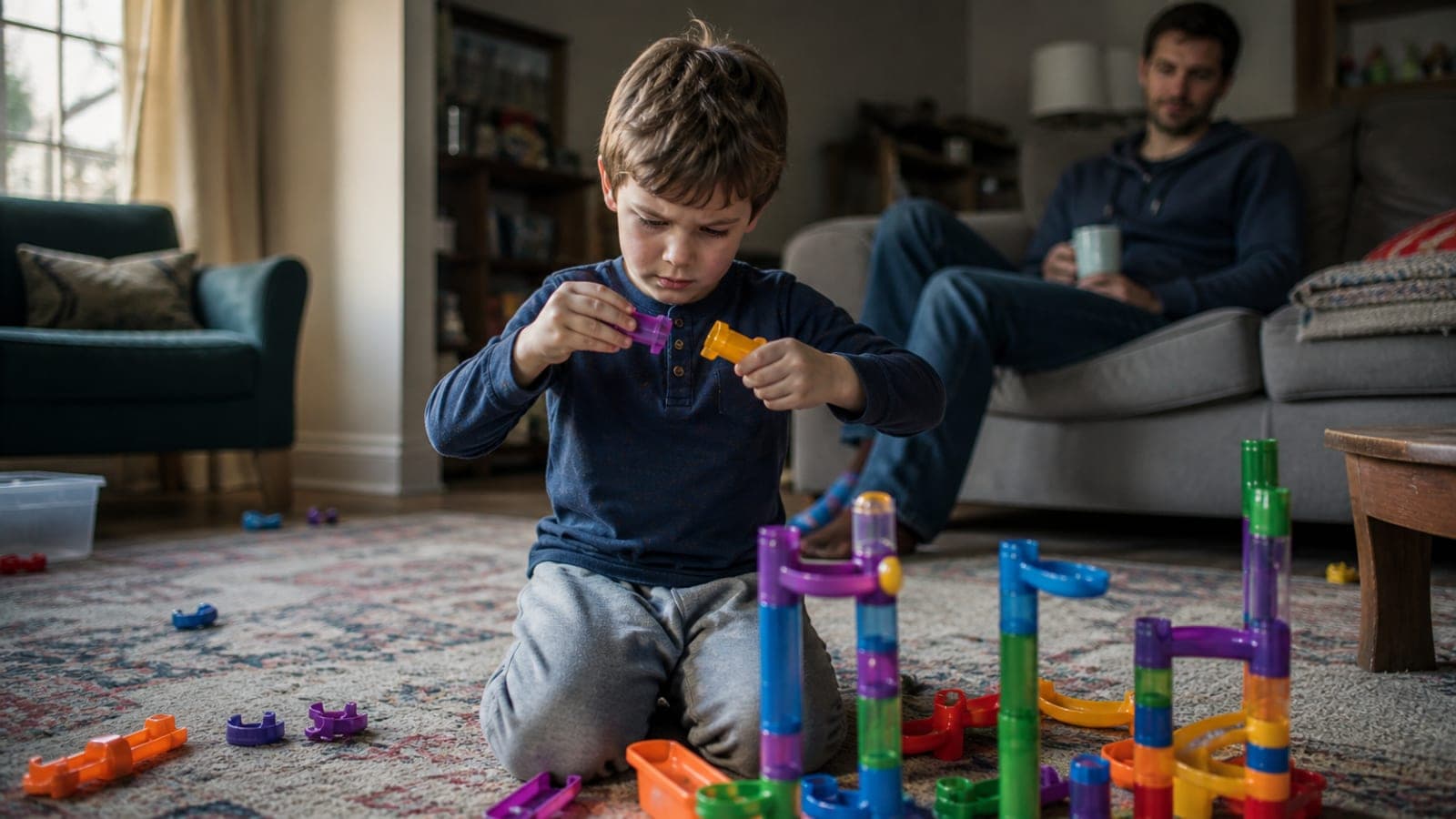
Which means the thing to change is not what you say afterward. It is what you do in the ten seconds after they stall, because the research is fairly blunt about this: stepping in and finishing it for them makes the next attempt shorter, not longer.
What giving up actually looks like at four, five and six
Watch closely and you will often see the quit arrive before the attempt. "I can't do it" gets said over a puzzle the child has not touched, or a shoe that is half on. That ordering is the useful clue. The child is not reacting to failure. They are forecasting it.
The scenes parents describe on forums are remarkably consistent: the drawing crumpled because one wheel came out wrong, the bike abandoned after a single wobble, the tower swept off the table the moment it leans. What connects them is not how hard the task was. It is that the child could see the gap between what they wanted and what they had made, and the fastest way to close that gap is to stop.
This is ordinary between three and six. It is also not something every child simply grows out of, because the habit confirms itself. Each quit is one more small piece of evidence that hard things do not come good.
The finding that flips the usual advice
Here is the study worth knowing about, because it points at the adult rather than the child.
Researchers at the University of Pennsylvania ran an observational study with 34 children aged four to eight, then two preregistered experiments with 150 four- and five-year-olds. Children who had watched an adult take over a difficult task persisted less on a later task of their own than children who had been taught or simply left to it. Reframing why the adult stepped in did not undo the effect.
Notice what was measured. Not the puzzle the adult finished, but the next one. Taking over does not only complete a task. It seems to pass on something about how long a person is supposed to keep going.
The companion finding runs the other way, and it is the more useful of the two. Across an initial study and two preregistered experiments with 262 infants, 15-month-olds watched an adult either struggle visibly before succeeding or succeed effortlessly, and were then handed a difficult toy of their own. Infants who had seen the effort made more attempts than infants who had seen the ease.
Fifteen months old. Long before they can describe what they saw, they are already copying how long you keep trying.
Four things that change it
Struggle out loud, on purpose
Most of us hide effort from our children, partly out of habit and partly because competence feels like the reassuring thing to model. The jar gets opened in the kitchen, the flat-pack gets assembled after bedtime, the work problem gets solved on a laptop with a neutral face.
So do it in front of them instead, and narrate it: "This lid is stuck. I'm going to try running it under hot water. That didn't work either. Right, tea towel for grip."
You are not performing frustration, and you are not asking for sympathy. You are showing the ordinary shape of a hard thing, which is several failed attempts followed by one that works. A child who has only ever seen the last part reasonably concludes that competent people succeed immediately.
Do not take the pen
This is the hardest one, because taking over is almost always kind, and it is usually faster.
When your child stalls, resist finishing it. Sit down next to them instead and give them the smallest possible piece of help: turn the puzzle piece so the straight edge faces out, hold the paper still, point at the part of the drawing that is already working. Help with the conditions, not with the task.
If you have already taken over, and everyone has, you have not damaged anything. The studies compared groups, not childhoods. What they suggest is which way to lean in the moment, and the direction to lean is toward doing less.
Praise the strategy, not the child
"You're so clever" and "you're such a good drawer" sound generous and quietly raise the stakes. If getting it right proves you are clever, then getting it wrong proves the opposite, and the safest move is not to try.
Praise what they actually did. "You kept turning it until it fit." "You started again with a bigger base." A study of parents and toddlers at home found that praise directed at effort between 14 and 38 months predicted the child's beliefs about ability five years later: those children were more likely at seven and eight to think ability grows with work rather than being fixed at birth.
The habit is small and worth building early, and it is the same instinct that helps when a toddler refusing to share is missing a skill rather than withholding one. Describe what happened, and let the child draw the conclusion.
It is also the same perfectionism showing up somewhere else entirely when a child says they don't like how they look: both are a belief that only the finished, correct version is acceptable.
Shrink the step, not the goal
The instinct when a child is defeated is to hand them something easier. It works for about four minutes and teaches the wrong thing, because the child learns that the response to difficulty is a smaller task.
Keep the goal and cut the step. If the tower keeps falling, build the base together and let them do the top. If the whole page of a drawing has gone wrong, ask for just the wheel on a fresh corner of paper. If the shoes are the battle, do the first shoe and hand over the second.
What they need is to finish something hard. That is a completely different experience from finishing something easy, and it is the only one that changes what they expect next time.
This is also why a construction toy whose walls actually hold is doing quiet perseverance work, which is part of why it ranks so high in our gift list for five-year-olds: a set that collapses under its own weight teaches a child that building things does not work.
When it is worth asking someone
Giving up quickly is not, by itself, a reason to worry at this age.
The things worth raising with your pediatrician are about intensity and range rather than persistence: distress after a small setback that lasts a long time and cannot be settled, avoidance that has spread across most activities rather than sitting in one or two, or a child who has stopped attempting things they were doing happily six months ago. Those are worth a conversation. Abandoning a puzzle is not.
Where a story does the work you cannot
The awkward part of teaching persistence is that the moment you most want to teach it is the moment nobody can hear you. Mid-collapse, your child is flooded, and anything you say lands as criticism of the thing that just went wrong.
So the lesson tends to arrive somewhere calmer, days earlier, in a story. A child who has watched a character keep going has a script to reach for later, and reading it is not a correction, so there is nothing to defend against.
The Boot That Wouldn't Quit was written for four to six, which is exactly when the forecasting habit sets in. It is a soccer story. Your child's lucky boot falls apart just before the final, and the book sits with the part that actually matters, which is what you do once the thing you were relying on is gone. The coach's line is the whole argument: it is not the boot that wins the day, it is the grit you bring to play.
Because your child is the one in the pictures, they are not watching someone else be brave about it. They are the one who keeps going, which is a different thing to be told.
The short version
A child who gives up easily has usually learned that trying and failing feels worse than not trying. That is a reasonable conclusion, and it is reversible.
Let them see you struggle. Keep your hands off the task. Say what they did rather than what they are. Make the next step small enough to finish.
Then let it take a year. It moves slowly, and it does move.
Frequently asked questions
Why does my child give up so easily?
Usually because difficulty has started to feel like information about them rather than about the task. Somewhere around four, children begin reading struggle as evidence of what they are capable of, and quitting is the fastest way to stop collecting that evidence. It is avoidance of a feeling, not a missing work ethic.
Is it normal for a 5 year old to give up quickly?
Yes. It is common between roughly three and six, and it often shows up as the quit arriving before the attempt, with 'I can't do it' said over a puzzle the child has not touched. It is worth working on, because the habit confirms itself, but on its own it is not a sign that anything is wrong.
Should I let my child quit when something is hard?
Let them stop, but try not to finish it for them. In two preregistered experiments with 150 children aged four and five, those assigned to watch an adult take over a difficult task persisted less on a later, separate task. Stepping back and offering a smaller next step tends to work better than either taking over or insisting they continue.
How do I build perseverance in a young child?
Let them watch you find something hard and keep going, narrate the strategy rather than the outcome, praise what they did instead of what they are, and break the task down so the next step is genuinely reachable. The aim is for them to finish something difficult, not to be given something easy.