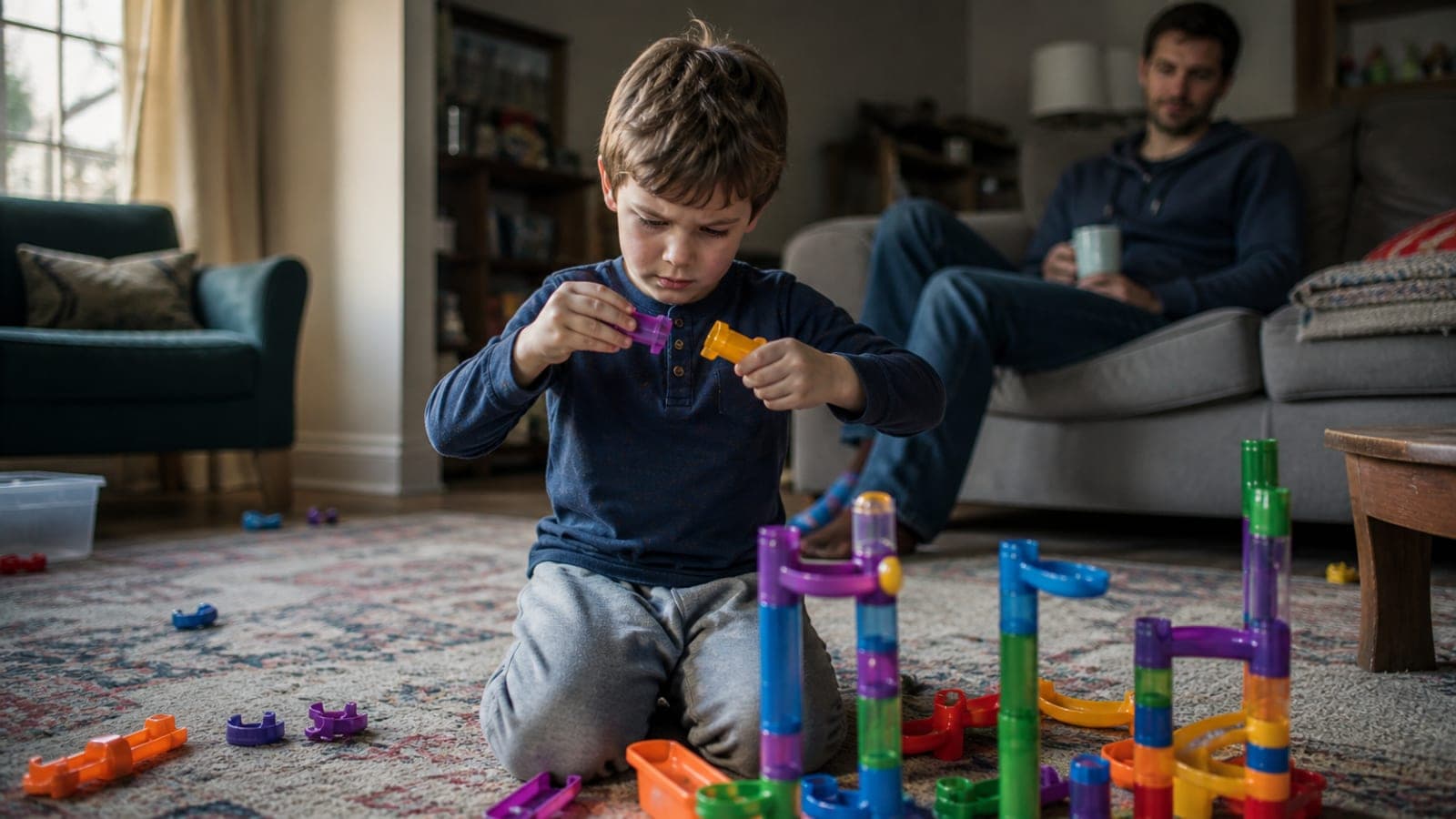
Key takeaways
- Reassurance is the reflex and it rarely lands. Telling a child they are beautiful contradicts what they just told you and leaves looks as the thing being scored.
- At four, five and six the complaint is usually about one feature and attached to one recent event. Ask what happened before you answer it.
- Among 395 children aged four to six, most picked their own body as their ideal. In the girls, the wish to be thinner rose from 18.5% at four to 36% at six.
- In seven and eight year olds, what tracked with body satisfaction was the child's self-esteem, their sense that other people demand perfection, and their mother's dissatisfaction with her own body.
- How you talk about your own body in front of them is doing more work than any sentence you find in the moment.
When a five-year-old says they wish they looked different, the reflex is to disagree. It is the wrong move. Telling a child they are beautiful contradicts something they have just risked telling you, ends the conversation, and quietly accepts the frame: that how they look is the thing being scored, and you simply disagree about the score.
Ask what happened instead. At this age the complaint is nearly always about one feature and attached to one recent event, which is a much smaller problem than the one you are picturing. And the thing with the most leverage is not the sentence you manage to find in the moment. It is what your child hears you say about your own body.
What this usually is at four, five and six
The first thing worth knowing is that this is not where most young children sit, so it is not a stage you are obliged to wait out.
In a study of 395 children aged four to six in Spain, most picked the body they believed they had as the body they wanted. The minority who wanted a thinner one grew with age: among the girls it rose from 18.5% at four to 36% at six. The same study found children reaching for reasons that had nothing to do with size at all, comparing arms and legs with the ones sitting next to them.
That last part is the useful bit, because a young child's version of this is rarely about size. It is hair that will not do what other people's hair does. Glasses. A gap in the teeth, a birthmark, freckles, ears, being the shortest in the line, being the tallest in the line, skin that does not match a cousin's. The complaint arrives specific, and it stays specific for a while.
It also arrives earlier than most parents expect. Infants register differences in skin color in the first year, and as early as age three children form judgments about people based on racial differences. A five-year-old noticing what they look like next to the other children is not precocious and has not been exposed to something they should not have been. They are on time.
Why "you're beautiful" makes it worse
It does three things at once, and none of them is what you wanted.
It contradicts. Your child has reported an experience and been told the experience is wrong, which teaches a fast, useful lesson about which subjects get argued with in this house.
It closes. There is nowhere to go after a denial except to repeat yourself, so the conversation that would have told you what actually happened at school never starts.
And it leaves the measure exactly where it was. The American Academy of Pediatrics puts self-esteem in terms of a gap: the closer a child's perceived self comes to their ideal self, the higher it runs. A gap can be closed from either end. Reassurance pushes on the perception and never touches the ideal, which is the end that is actually doing the damage.
Where the leverage actually is
Here is the finding that should change where you spend your effort.
Researchers followed a group of children through seven and eight, testing which of a long list of factors tracked with how satisfied they were with their bodies. Three came through: the child's self-esteem, socially prescribed perfectionism, and the mother's dissatisfaction with her own body. Parents' direct comments about weight and food did not, although the authors note those comments were rare in this sample, so read that as unproven rather than as harmless.
Two things follow. The first is that your own body talk is doing more work than your reassurance is. The second is that a large part of this is not really about appearance at all.
Socially prescribed perfectionism is the belief that other people require you to be flawless. It is measurable in a seven-year-old.
Those children are older than yours, so read it as a direction rather than a prescription.
What to say back
Ask what happened, before anything else
Not "why would you say that", which is a disagreement wearing a question mark. Try "what made you think about that today?" and then stop talking. Most of the time something specific comes out: a comment in the line for lunch, a photograph they saw of themselves, a cousin's hair, a cartoon where the character who looks like them is the funny one.
You cannot answer the thing until you know what the thing is, and a child who gets corrected first will usually decline to tell you.
Answer the feature, not the face
If they say their hair is wrong, talk about hair. Whose hair it is, where it came from, what it does that other hair cannot, how it works, why it needs different things. If it is glasses, talk about glasses.
This feels too small. It is not. Widening straight to "you are perfect exactly as you are" skips over the thing they actually raised and lands as the same denial in a longer form. Deal with the feature and the general reassurance becomes unnecessary, because you have just demonstrated the point rather than asserted it.
Three openings that work better than a denial
"What made you think about that today?" Finds the event. Almost always there is one.
"Which bit?" Turns a global verdict back into the specific complaint it started as, which is a much easier thing to talk about.
"Whose hair is like yours?" Puts the feature into a family and a history instead of leaving it as a defect your child appears to have acquired alone.
Say what the body is for
Move the subject from how it looks to what it does. Not as a slogan, and not today, in the middle of the conversation, where it will sound like a change of topic because it is one.
Do it on ordinary days. Legs that got all the way up the hill. Hands that can do the buttons now. Eyes that found the cat first. A body described as something that works, repeatedly and without ceremony, is harder to think of as something that is failing to look right.
Stop scoring your own body out loud
This is the one the research points at hardest, and the one nobody wants.
The comment in the mirror on the way out. The photograph deleted with a noise. The "I look enormous in this". The diet mentioned at the table. None of it is addressed to your child and all of it is heard by them, and what it teaches is not that you have a problem with your body. It is that bodies are things that get graded, by the people who love you, out loud, in the kitchen.
You do not have to feel differently about your own appearance. You have to stop narrating it.
Change what is in the room
Look at what your child sees on an ordinary Tuesday. The books on the shelf, the dolls in the box, the shows on in the background, the pictures on the wall, who comes to the house. If the only faces in it that look like theirs are their own family's, the message that their kind of face is the ordinary kind has to travel entirely through you.
This is slow and it is unglamorous and it works better than talking does.
The part that hides behind appearance
Perfectionism in a young child does not announce itself as perfectionism, and it almost never announces itself as being about looks.
It is the drawing crumpled because one wheel came out wrong. The refusal to be photographed. The fourth outfit of the morning. "I look silly" said about a coat that is fine. What connects them is a belief that acceptance is conditional on getting it right, and appearance is simply the version of getting it right that is on display all day.
Which is why this sits so close to a child who gives up easily the moment a drawing goes wrong: it is the same machinery pointed at a different target. If you are working on one, you are working on both, and the thing that helps in either case is the same. Make it survivable to be imperfect in front of you, visibly and often.
When it is worth asking someone
One upset sentence after a hard day at school is not a warning sign, and treating it as one teaches your child that it should have been.
What is worth raising with your pediatrician is duration and spread: distress that lasts weeks rather than minutes, avoidance that has started to cost them things they used to like, refusing to be seen changing or swimming, new restriction around food, or a child who has stopped wanting to leave the house. Those are worth a conversation. Not liking your ears at five is not.
Where a story does the work you cannot
The awkward thing about this subject is that the moment you most want to make your case is the moment your child is least able to hear it. Anything you say while they are upset about their own face reads as a correction, and a correction is exactly what the feeling is already made of.
So it lands better somewhere calmer, days earlier, in a story that is not about them being wrong.
The Princess Who Kept Going was written for four to eight. The Grand Celebration is tomorrow, and the crown, the dress, the speech and the dance are all going to be perfect. None of them are. The paint spills, the dance wobbles, the cake is sat on, and the book stays with the part that matters, which is that being loved was never about being perfect in the first place.
What makes it land differently from a book about a child who looks nothing like yours is that your child is the one in the illustrations, drawn from a photograph of them. The glasses stay. The freckles stay. The hair stays.
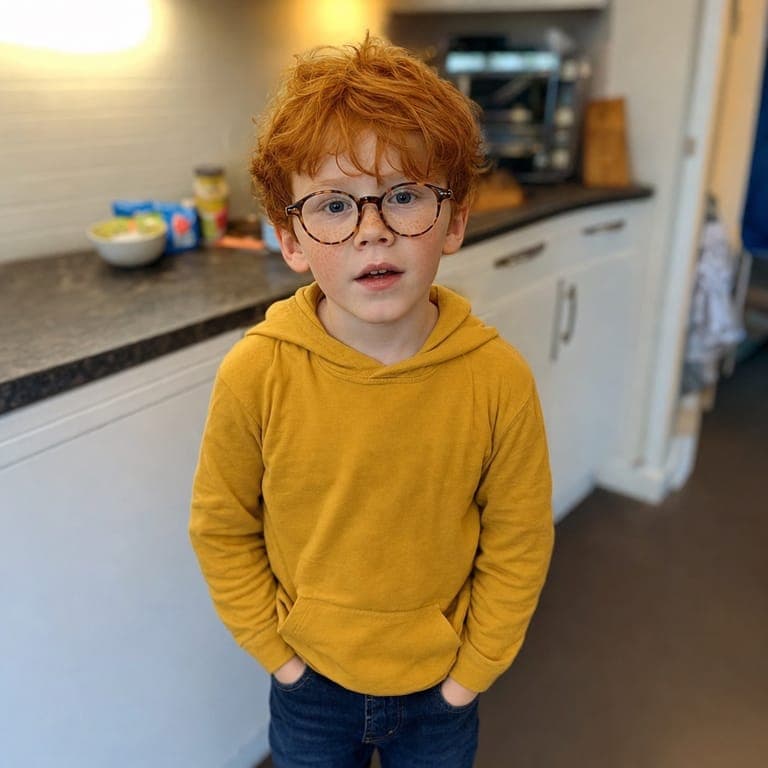
Photo you upload

Character in the book
A child who does not like their glasses spends the whole book watching a hero in glasses. Nobody argued with them, nobody told them the glasses were lovely, and the glasses were never the problem being solved. They were just what the main character looks like.
The short version
Do not disagree. Ask what happened, and answer the feature they actually named.
Then go and do the two slower things: talk about what bodies do rather than how they score, and stop grading your own out loud where they can hear you.
It moves slowly. Most of it is not about the sentence you say tonight.
Frequently asked questions
What do I say when my child says they are ugly?
Start by asking what happened today rather than disagreeing. At four, five and six there is nearly always a specific trigger, and a child who is contradicted first usually stops explaining. Once you know what set it off, answer the actual feature they raised instead of jumping to how lovely they are.
Is it normal for a 5 year old to not like how they look?
It is common enough to be unremarkable, and it is usually narrow rather than global. Most young children pick their own body as the one they want, and the ones who do not are typically unhappy about a single feature such as hair, glasses, teeth or height rather than about themselves in general.
Should I tell my child they are beautiful?
Saying it warmly and unprompted is fine. Using it as a rebuttal is what backfires, because it argues with something your child has just risked telling you and quietly agrees that looking good is the measure. Praise that has nothing to do with appearance does more, because it moves the measure somewhere else.
When should I worry about my child's appearance concerns?
The things worth raising with your pediatrician are duration and spread: distress that lasts weeks rather than minutes, avoidance of photographs, mirrors, swimming or dressing in front of anyone, changes in eating, or a child who has stopped doing things they used to enjoy. A single upset comment after a day at school is not that.