Key takeaways
- The one thing a grandparent reliably wants more of is the grandchild. Buy something that carries the child into their house, not another object for the shelf.
- A personalized book with both of them in it is the only gift here that is about the relationship rather than about managing the distance.
- Buy for the ten months between visits. Anything that needs them to remember to use it will quietly stop being used.
- The video calls are free. What you can buy is a reason for the call to be about something, and something for the days when there is no call.
- Set it up before you send it. A gift that arrives needing an account and a password is a gift that stays in the box.
The gift that works for a grandparent who lives a long way off is the one that puts the grandchild in their house on an ordinary Tuesday. They are not short of objects. They are short of the small, unremarkable days that the relatives who live nearby get for free, and most presents aimed at them turn out to be souvenirs of the last visit instead.
Six specific things below, with what each one actually is and what it does in the ten months between visits. The video calls are free and they are not the gift. What you can buy is a reason for the call to be about something, and something for the days when there is no call.
Emberly makes one of the products recommended in this article.
What distance actually does
The problem is not logistics. Michael Rich of the Harvard Chan School, asked whether babies understand video chatting, put the real difficulty in one sentence: he wants grandparents to establish themselves as real, three-dimensional, living and breathing people before the video chatting starts, because otherwise they are just an image on the screen. A grandparent seen twice a year is not competing with other presents. They are competing with everything else that has ever appeared on a screen in that living room.
The calls are still worth defending. The American Academy of Pediatrics is relaxed about them in a way it is about almost no other screen, treating family video chat as relationship time rather than screen time, and it notes that toddlers can learn new words when they talk to an adult through video chat, particularly one who smiles, responds and builds on what the child has just said. Surveys taken during the pandemic found that grandparents felt closer to their grandchildren when they had more frequent video chats.
The AAP's practical tip is the one that decides what to buy. It suggests linking it with another activity: call at mealtimes, keep the same toys nearby, have the person on the screen read the child a book. A call with a four-year-old and no agenda collapses almost immediately. A call with something in it can run as long as the child wants.
None of this is new. A Penn State extension piece for long distance grandparents, written when the technology was cassette tapes, still has the best line anyone has written on the subject: To be important to your grandchild, you don't need everyday contact. Its suggestion was to post a recorded letter instead, because The children can play them over and over again and a taped letter is easier for a small child to follow than a written one. The cassette is gone. Half of what follows is the same idea with a different battery in it.
The relationship is also worth more than it looks. One study followed 205 children from around age ten into their thirties, and the ones who had been close to a grandparent in childhood reported lower depressive symptoms as adults. A small effect, and a long time for one to last.
So, three tests for everything below. Does it keep working when nobody remembers to use it? Does it give the next call something to be about? And is it still being used a month after it arrives?
The list
1. An Emberly personalized book
Ours, and the only thing here that is about the two of them rather than about the distance.
I Love Grandma is written for two to six year olds, and it is the title in our catalogue where the grandparent is in the story too. You upload a photograph of the child and a second one of Grandma, and she is built as her own character across the illustrations rather than appearing as a name in the text. The two of them are on the page together, baking at the kitchen table and getting muddy in the garden. The name printed in the story is whatever the family actually calls her, so it can be Nana or Mimi or Grandmummy, which matters more than it sounds like it should: the word a three-year-old says is rarely the word "Grandma".
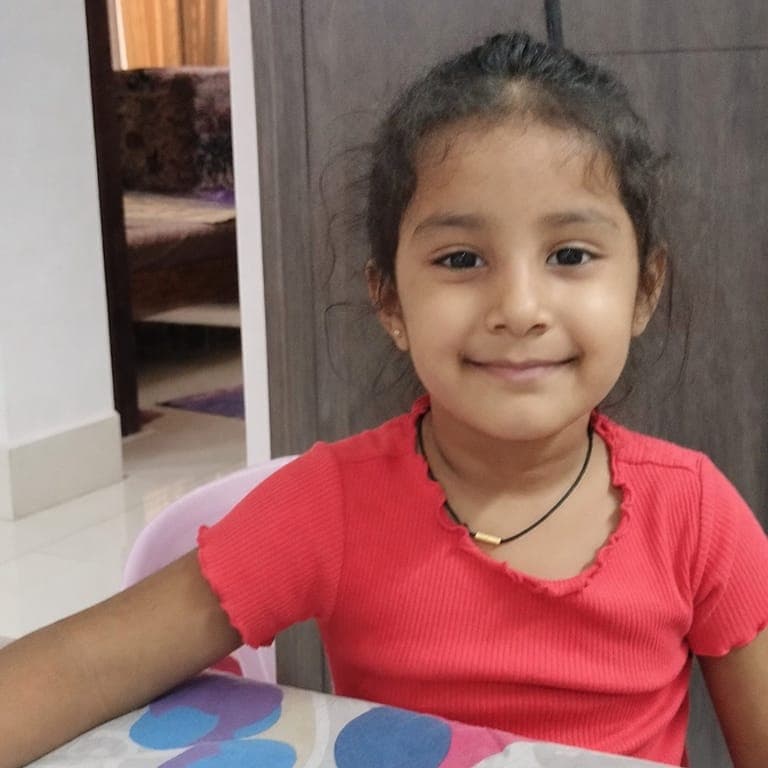
Photo you upload

Character in the book
Hardcover is standard, and you see the finished book before you pay.
Why it works at a distance: it is the activity the AAP suggests attaching a call to, sitting on a shelf waiting. Grandma reads it down the camera and the child follows along at the other end, and on the nights there is no call it gets read anyway by whoever is doing bedtime. A book the child is inside is the shortest route there is to the idea that Grandma is a person who exists in a house somewhere, rather than a face that appears on a phone on Sundays.
2. Aura Carver Mat digital frame
A 10.1 inch landscape frame running at 1280 x 800, which takes pictures over wifi from anyone invited to it. Aura is blunt about the part that matters here: Family and friends can add photos from anywhere, with no subscription and no storage limit on photos or videos. You can also preload the frame with pictures and a message before you hand it over, by scanning the code on the back of the box.
Why it works: it asks nothing of the recipient after the first plug-in, and it never stops. The usual photo present is a snapshot of one moment, chosen and printed and finished. A frame that the child's parents empty their camera roll into on a Sunday night is the ordinary Tuesday, delivered, and it keeps arriving long after everyone has stopped thinking of it as a present.
Preload it before you send it. A frame handed over empty puts the setup on the person least likely to enjoy it, and a frame that sits blank for a fortnight never really starts.
3. Chatbooks Monthbooks
A photo book subscription rather than a one-off album. A Monthbook is a 60-page photo book, available in soft or hardcover and in 5x7, 6x6 or 8x8, arriving four, six or twelve times a year. Pictures are pulled from the camera roll, Google Photos, SmugMug, Flickr or HeyFam, and Chatbooks ships them to the US, UK, Canada, New Zealand and Australia.
Why it works: parents comparing notes on what to buy the grandparents land on the same two conclusions again and again. Most grandparents genuinely do not want another object, and the exception is always photographs, because those are the ones they will sit with for an hour. A frame needs power and a network. A book needs a lap, and it works in the chair by the window where the wifi is weakest.
This is the one to buy for a grandparent who has politely declined every gadget anyone has ever given them. There is nothing to join and nothing to charge, and the only decision they ever make about it is where to put the last one.
4. Lovebox Photo Messenger
A wooden box with a 320 x 240 screen that receives photos, drawings, stickers and messages sent from a phone app. The heart of the Lovebox will spin when something new arrives, and keeps spinning until the lid is opened. It needs 2.4GHz wifi at their end and nothing else.
Why it works: in everything else on this list the child is the subject. Here the child is the sender. A four-year-old cannot write a letter, work a phone or remember to call, but they can hold up a drawing they did that afternoon, and the thing that turns up in a kitchen a long way off was made by them today.
The spinning heart is the part that earns the price. A message that arrives silently is a message discovered on Thursday. A box that has visibly been waiting all day is one the grandparent walks past and opens, which is the difference between a gift and a notification.
5. A Creative-Tonie with a story on it
A hand-painted figure holding up to 90 minutes of your own stories and songs, uploaded from a phone, tablet or computer, and played by standing it on a Toniebox. Tonies name this exact use on their own page, suggesting grandparents record messages from afar.
Why it works: it is the Penn State cassette letter without the cassette. A recorded story does the one thing a live call cannot, which is repeat. A three-year-old who loves something asks for it again, and again, and no grandparent can be on the phone that many times. The figure can sit on the shelf and be picked up at four in the afternoon by a child who wanted to hear that voice and did not want to talk to anybody.
The honest caveat is that it only plays on a Toniebox, so this is the right gift when the grandchild's house already has one and the wrong gift when it does not. It is also the one item here that physically lives at the child's end, which is rather the point: it is the grandparent, in the room, without anyone having to arrange a time.
6. StoryWorth
Weekly questions by text or email, answered however suits the person answering, by replying to the email, writing on the site, or recording their voice over the phone. A year of answers is printed at the end as one hardcover book.
Why it works: it is the only gift here aimed at what the grandparent knows rather than at what they are missing. The grandchild is not the only person at risk of becoming an outline at this distance, and the questions get asked while there is still somebody there to answer them. The grandchildren end up holding the answers to things they will not think to ask about for another twenty years.
Weekly is also the right rhythm. It is a small standing appointment with the family rather than a project, and unlike every other well-meant memoir gift, it never sits there as a blank notebook accusing anybody of anything.
Choosing between them
If you are buying one thing, buy the personalized book. It is the only present here that is about the relationship rather than about administering it, and it is the one the child takes off the shelf without being asked.
If the grandparent has never willingly set up a device in their life, buy the printed books rather than the frame. Nothing to plug in, nothing to join, and nobody has to talk them through it on the phone.
If the grandchild is under about three, weight everything toward the voice and the face arriving without an appointment. At that age a scheduled call is the least reliable part of the week, and the things that work are the ones the child can start alone.
And if they have said they do not want more things, believe them. Buy the one that arrives, gets looked at and is replaced by the next one.
What to skip
Mugs, slogans and anything that announces the relationship. "World's Best Grandma" is a present about the category rather than the person, and it fails for the reason a big sister shirt fails as the main present: it asks somebody to advertise a role instead of giving them anything to do in it.
A keepsake that is only for looking at. Engraved silver, a framed cast of the handprints, anything destined for a cabinet. The argument for a christening keepsake that gets read rather than admired is the same argument one generation up.
Anything whose subscription they have to manage. The test is whose account it is. If the benefit depends on them remembering a password, the benefit quietly stops a few months in and nobody mentions it.
A tablet, as a general-purpose answer. It arrives as a present and turns into tech support, and the calls come back to whoever bought it.
Something that only works during a visit. A game kept at their house is a lovely thing and it is not on this list. By design, it works twice a year.
The short version
Buy the personalized book first, because it is the one thing here that is about the two of them rather than about the miles. Then pick a single channel that runs without anybody remembering it, and stop. Three half-used gadgets are worse than one that works.
The calls are free, and they were never the gift. What you are buying is the ordinary Tuesday. What a grandparent gives the grandchildren at Christmas is the same argument running in the other direction, and it arrives at the same answer: be there in the unremarkable weeks, not only the photogenic ones.
Frequently asked questions
What do you buy grandparents who live far away?
Something that carries the grandchild into their house between visits, rather than something that commemorates the last one. A personalized book with both of them in it is the strongest single answer, because it is about the relationship itself rather than about managing the miles. After that, pick one channel that keeps running without anybody remembering it: a digital frame the parents drop photos into, a printed photo book that arrives on a schedule, or a small box that receives the child's drawings.
What can a grandparent send a grandchild who lives far away?
Their voice, mostly. A personalized book they can read aloud on a call is the version that works while you are both there, and a recorded story the child can replay without an adult arranging anything is the version that works on the days there is no call. A Penn State extension piece for long distance grandparents made the same point back when the technology was cassette tapes: a child can play a recorded letter over and over, which is more than can be said for a written one.
Do video calls actually work with a toddler?
Better than they look, and much better with something to do. The American Academy of Pediatrics treats video chat with family as relationship time rather than screen time, notes that toddlers can learn new words from an adult on video who smiles, responds and builds on what the child says, and suggests linking the call to another activity: a mealtime, the same toys nearby, or having the person on the screen read the child a book. Surveys during the pandemic also found grandparents felt closer to their grandchildren when they had more frequent video chats. A personalized book at the grandparent's end is the easiest version of that activity to arrange.
Is a digital photo frame a good gift for a grandparent?
Yes, with one condition: somebody else has to fill it. A frame the grandparent is expected to load is a frame showing whatever was on it the day it arrived. Set it up and preload it before you send it, and make sure at least one parent has the app on their phone. If nobody in the family will do that reliably, a printed photo book on a subscription is the better buy, and a personalized book is better still, because it needs no power, no network and nobody to maintain it.
How old does a grandchild need to be for any of this to land?
Around two. Below that, most of it is really for the adults, which is fine and worth knowing. Two to six is where a personalized book with the grandparent in it does the most work, because that is the age at which a child is working out that the face on the screen belongs to a real person who lives in a house. From about seven they start sending their own messages and the problem changes shape.